Two years ago, the waitlist at most cosmetic clinics was for lip filler. In 2026, the waitlist is to have it removed.
Across North America, a quiet reversal is underway. Women aren't booking dissolution appointments because their filler migrated or went wrong — the standard complications. They're booking because the look itself has expired. The overfilled lip, once the defining feature of a beauty era, has become something women actively want undone.
And the growing conversation around lip blush vs lip filler reveals something deeper than a debate about technique. It's a fundamental rethinking of what enhanced lips should even look like.
If you've been following the broader push for transparency in Canadian beauty, this tracks. The same impulse — less performance, more honesty — is reshaping how women think about their lips.
What 'Filler Fatigue' Actually Looks Like
For nearly a decade, hyaluronic acid fillers were the lip standard. Juvederm, Restylane, Volbella — the brand names became as familiar as any lipstick shade. At its peak, the 'Instagram face' was a multi-billion-dollar industry built on a single premise: more is more. Bigger lips. Sharper cheekbones. A face sculpted to photograph well from every angle. The look transcended demographics — it was aspirational in Seoul, São Paulo, and Winnipeg alike.
Then the mood shifted. Business of Fashion documented the turn: the overly augmented look is fading as beauty culture moves toward structure over excess and natural facial harmony. Canadian publication Fashion Beauty Runway called it 'imperfect beauty' — a backlash against filler culture and AI-generated perfection. The term captures a specific mood: a preference for faces that look lived-in rather than manufactured.
Dermatologists have their own name for it: filler fatigue. Not a medical complication — an emotional one. The slow toll of watching your face drift further from the person underneath with every appointment. The Harley Street Journal reports a marked increase in dissolution consultations over the past two years. These patients aren't fixing botched work. They're choosing reversal because the aesthetic itself no longer resonates.
Part of what makes filler fatigue so insidious is that it happens gradually. Each appointment looks fine — a half-syringe here, a touch-up there. But hyaluronic acid doesn't fully dissolve between sessions. It migrates, accumulates, subtly reshapes. After three years of regular appointments, the person in the mirror can look quite different from the person who first sat down. That slow drift — not a single bad experience but a cumulative realization — is what drives the reversal.
The numbers back this up. A global wellbeing report found that 71% of consumers now believe society overemphasizes physical appearance, with 47% prioritizing self-confidence over looking any particular way. When three-quarters of your audience questions the very premise of cosmetic enhancement, the industry either adapts or becomes irrelevant.
Lip Blush vs Lip Filler: More Than a Technical Difference
So if women are dissolving their filler, have they given up on lip enhancement? Not remotely. The permanent makeup market was valued at $1.8 billion in 2025 and is projected to reach $3.7 billion by 2034 — 8.4% compound annual growth. That's not the trajectory of a niche treatment. This growth is driven by the same women who loved filler, now choosing a different path to the same destination.
Lip blushing — a semi-permanent cosmetic tattoo that deposits pigment into the lips to enhance natural colour and definition — is one of the fastest-growing segments. PMU market research puts it at roughly 13.8% of the permanent makeup market. And climbing.
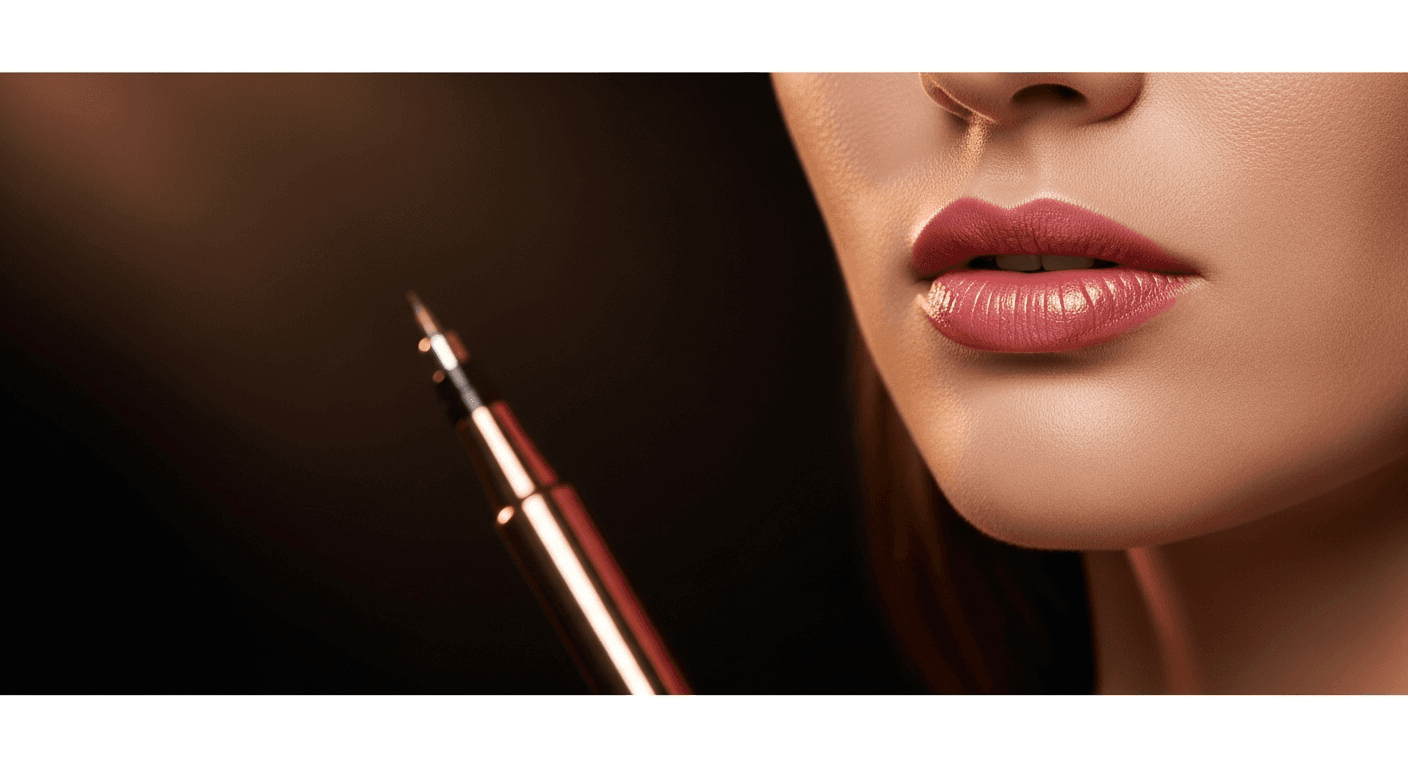
The difference isn't just technical. Lip filler changes structure — it adds volume, reshapes borders, creates a silhouette your lips didn't have before. Lip blush changes nothing about your anatomy. It enhances what's already there: a flush of colour, a more defined lip line, the look of someone who woke up with naturally radiant lips.
The shade is customized to you — soft nude, warm rose, deep berry — but the effect is always effortlessly polished. Where filler announces <em>I changed my lips</em>, lip blush whispers <em>I've always looked like this.</em> In a cultural moment that prizes authenticity above almost everything, that quiet confidence is the entire point.
The procedure takes about two hours. A customized pigment is selected, the lip shape is mapped and confirmed before any work begins, and the result heals over roughly ten days into a natural-looking flush. Results last two to five years depending on skin type, fading gradually rather than disappearing all at once.
There's no swelling, no 'duck lip' recovery phase, no awkward explanation for why your lips tripled in size over the weekend. The most common reaction from clients who've experienced both filler and lip blush? How refreshingly unremarkable the entire process feels.
As WWD noted in their 2026 aesthetics forecast: the through-line is 'less is more' — smaller, more subtle, more beautiful. Lip blush is that principle applied directly to your face.
If the comparison has you rethinking your approach, every LaviLash consultation starts with an honest conversation about what will actually suit your features — no commitment, no upsell. Just Dao's 12 years of artistry experience applied to your specific face.
Why This Hits Different on the Prairies
There's a practical dimension to this conversation that trend pieces written in Los Angeles tend to miss. In Winnipeg, lips crack in minus-40 winters. Lipstick that 'lasts all day' rarely survives a face-full of January wind. And filler can behave unpredictably through extreme temperature swings.
A semi-permanent lip colour that looks natural whether you're at a patio on Corydon in July or scraping your windshield in February solves a distinctly Prairie problem. It's enhancement that doesn't ask you to reapply, touch up, or worry about it. For a province where practicality isn't just a preference but a survival skill, that resonates in ways no trend forecast can capture.
It's the same instinct behind the skinification movement in lash care — the idea that beauty should work with your life, not demand a second job. For women who've always been more pragmatic than performative about their routines, lip blush doesn't just fit the cultural moment. It fits the Tuesday morning school drop-off.
The post-filler era isn't about wanting less. It's about wanting differently — colour over volume, definition over inflation, your own face with the saturation turned up just slightly.
That's not a backlash against beauty. It's beauty finally growing up.
If all of this has you rethinking what lip enhancement could look like, book a consultation — it's the fastest way to get advice specific to your features. Or if the artistry behind permanent makeup has sparked something else entirely, explore the LaviLash lash course. The demand for these skills is only accelerating.

